
Bistro Lab
Defensible Chemical Forensics.
A decision support engine for complex investigations. Fuses lab data and scene context using bipartite synthesis to score competing hypotheses.
Context-aware reasoning
Designed to support—not replace—human expertise. Combines lab analytics, field intelligence, and historical cases. Each hypothesis quantifies how content and context reinforce or challenge a theory, providing experts with transparent rationale for their decisions.
Ambiguity management
Uses simulated quantum interference to suppress unlikely theories and highlight exactly what missing evidence would drastically shift confidence.
Visual intelligence
Uses modified Sankey diagrams to show weighted diagnostic pathways from observation to outcome.
Courtroom-ready auditability
Full mathematical transparency for every inference, ensuring findings are defensible.
Capabilities
Turning evidence into confident counsel.
Fuse spectra, chromatography, environmental data, and chain-of-custody notes into a single evidence canvas.
Rank possible materials, mixtures, and intents with quantitative weighting pulled from the bipartite model.
Generate investigator-ready narratives that explain how observations support or refute conclusions, ready for reporting or courtroom review.
Capture expert rationale to preserve institutional memory and accelerate training of new analysts.
Content meets context
Weighted pathways from observation to outcome.
Bistro Lab maps how chemical observations on the left connect to investigative outcomes on the right. Flow thickness represents the strength of each pathway—showing how content and context combine to support or challenge competing hypotheses.
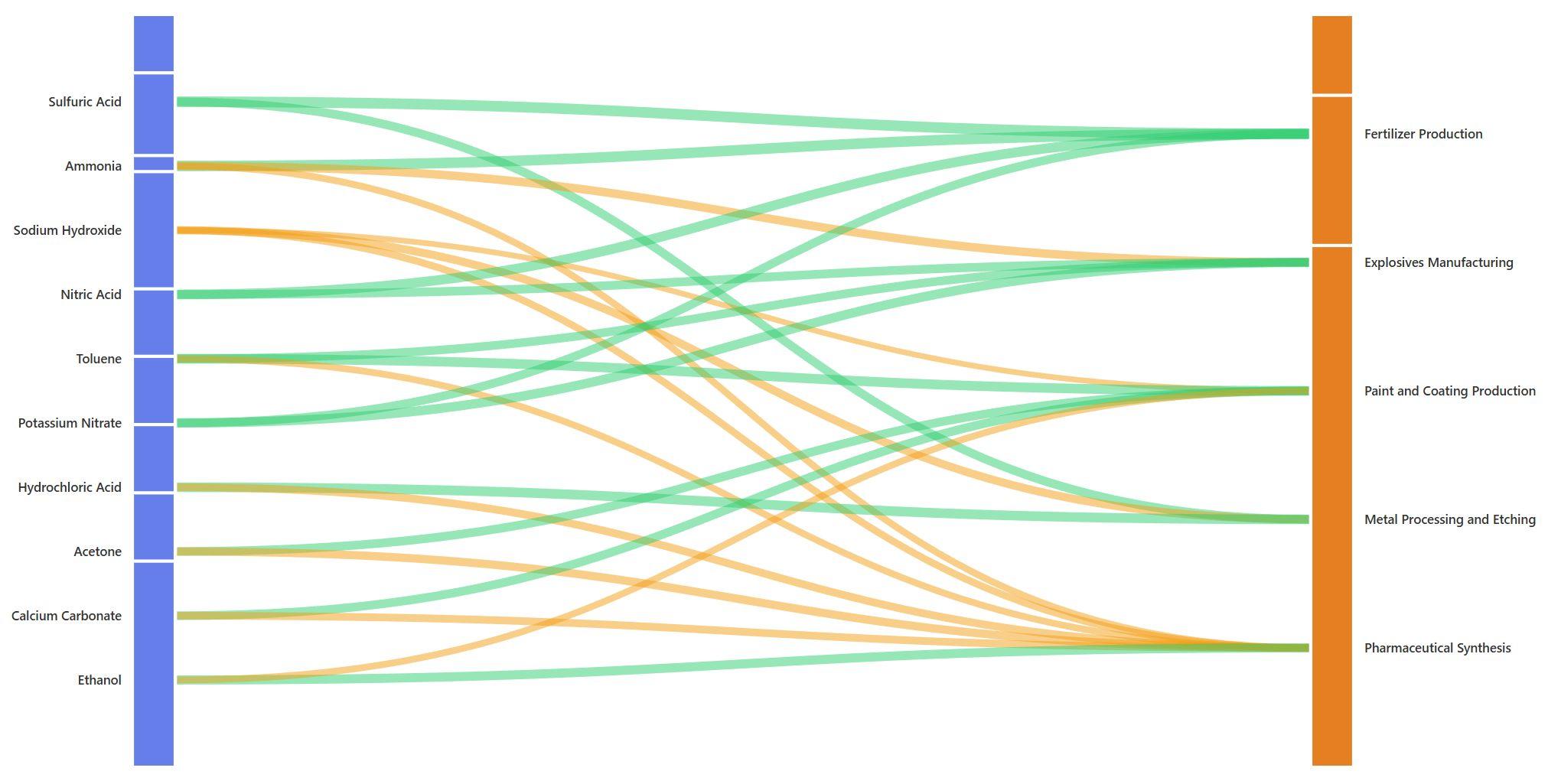
Example: Chemical observations flow through bipartite analysis to relevant application contexts, with pathway strength indicating diagnostic and contextual importance.
Analyst workspace
A single environment for data, dialogue, and decision.
Bistro Lab blends instrument integrations with investigative storytelling. Evidence tiles show their contribution to competing hypotheses, while rationale threads capture how analysts arrive at a conclusion. Everything remains auditable for internal QA or legal review.
- Weighted scoring dashboard reveals convergence and divergence across evidence types.
- Scenario sandbox allows teams to simulate what-if cases, training new analysts in realistic conditions.
- Secure export produces courtroom-ready reports with traceable provenance.
- Privacy layers enforce need-to-know visibility while still enabling collaborative insight.
Roadmap toward trusted, distributed forensic intelligence.
Bistro Lab is growing through close collaboration with forensic chemists, law enforcement, and investigative partners. Here is how the program is unfolding.
Partnering with forensic labs to refine workflows and align with evidentiary standards.
Delivering hybrid architectures that keep sensitive data on-premises while enabling selective cross-team learning.
Establishing privacy-preserving exchanges so teams can benefit from anonymized insights across jurisdictions.
Let’s co-develop the future of forensic intelligence.
We are facilitating design-partner cohorts to ensure Bistro Lab meets operational, regulatory, and evidentiary demands from day one. Share your priorities and we will align the right pilot structure.